Impressions made into the stone, and strange knobs, or nipples, on the stones; it seems as if there was no problem at all to do anything with the stone that they wanted to do!
Walls were not even a needle enters between the stone blocks. They can be found in different forms and sizes, but the general characteristic is the perfect fit, and als the knobs and impressions into the stones are generally present. The vitrified part is normally found on the borders. Sometimes also on other parts of the stone blocks we can recognize vitrification. Another characteristic of these walls is the print that the upper laying stones left on the lower laying stones, as if the weight of the upper stones gave the print in the once softer underlying stones.
Impressions that do not look like having been made with hammer and chisel but more look like a result of the pressure applied to a once softer rock (like a sort of clay), can be found also on these walls.
The knobs do not have a regular pattern, and can be found on different types and sizes of stones. Have a look at the slideshow below to get a good idea.
Español:
Impresiones hechas en la piedra, y perillas extrañas, o pezones, en las piedras; parece como si no hubo ningún problema en absoluto para tratar la piedra como querían!
Las paredes en donde ni siquiera una aguja entra entre los bloques de piedra. Se pueden encontrar en diferentes formas y tamaños, pero la característica general es el ajuste perfecto, y generalmente las perillas y las impresiones en las piedras están. La parte vitrificado se encuentra normalmente en los bordes. A veces también en otras partes de los bloques de piedra podemos reconocer la vitrificación. Otra característica de estos muros es que las piedras de colocación superior dejaron en las piedras de abajo una impressión, como si el peso de las piedras superiores dio esa huella a a las piedras de abajo porque fureon suaves.
Otro tipo de impresiones que no aparecen como si hubieran sido hechas con el martillo y el cincel, pero que se ven como un resultado de la presión aplicada a una roca, que alguna vez fue más suave (como una especie de arcilla), también se puede encontrar en estos muros.
Las perillas no muestran un patrón regular, y se pueden encontrar en diferentes tipos y tamaños de piedras. Echa un vistazo a la presentación de diapositivas para obtener una buena idéa como se ven estas impresiones y perillas.
Photo Gallery by QuickGallery.com
Sunday, September 28, 2014

Friday, April 25, 2014
Were high ages in antiquity possible because of less gravity?
One of the mysteries of the remote past is that people seem to have been able to reach high ages. References to those high ages can be found in for example the Bible or in stories on pre-dynastic egyptian kings and Gods. See these words in an article by Antoine Gigal;
From; http://www.gigalresearch.com/uk/publications-pharaohs.php by Antoine Gigal:
What if these numbers were actually for real? Alfredo Gamarra found during his research an interesting reference that could explain longer lifes in the past. Based on his idea that gravity in the past was less, he heard about the Russian astronauts that were for a long time in space, and of whom it was detected that the process of cell renewal slowed down significantly in space. Reasoning that we only have a limited number of times that we can renew our cells, and that this number defines how long we could live, it is logic to think that one could live longer if this renewal process is slowed down.
A few more indications that these ideas are valid can be mentioned, for example with the loss of bone mass of astronauts in space;
From; http://members.nova.org/~sol/station/hazards.htm :
Less stress on the body and bones, theorically means that the body could grow taller. Sealife, thanks to the gravity force being compensated for the biggest part by the buoyancy effect, can indeed grow bigger than land life. Even astronauts grow a few inches taller in space thanks to less stress on the spine, although being full grown persons:
See http://www.nasa.gov/audience/forstudents/5-8/features/F_How_Youve_Grown_5-8.html :
With this principle of less gravity in the past in mind, one could also see the giant scale and the not yet understood sophisticated technology of ancient sites, in another light.
Don't forget to download the ebook 'The Discoveries of Alfredo Gamarra', give me the like on the fanpage so you can download it!
From; http://www.gigalresearch.com/uk/publications-pharaohs.php by Antoine Gigal:
This possibility of living thousands of years or hundred of years is normally interpretated differently; it does not fit the present paradigm about ancient cultures. It is than calculated towards more credible numbers, reasoning that they might not have been calculating in years. Still these references to longer lifespans exist.
Unimaginably Long Reigns
What if these numbers were actually for real? Alfredo Gamarra found during his research an interesting reference that could explain longer lifes in the past. Based on his idea that gravity in the past was less, he heard about the Russian astronauts that were for a long time in space, and of whom it was detected that the process of cell renewal slowed down significantly in space. Reasoning that we only have a limited number of times that we can renew our cells, and that this number defines how long we could live, it is logic to think that one could live longer if this renewal process is slowed down.
A few more indications that these ideas are valid can be mentioned, for example with the loss of bone mass of astronauts in space;
From; http://members.nova.org/~sol/station/hazards.htm :
'Bone and Muscle Loss - Weightlessness triggers bone mineral loss, where the density of weight-bearing bones (e.g., pelvis and leg bones) declines at the rate of one to two percent per month. Mimicking osteoporosis, the process begins with the atrophy of large weight-bearing muscles in the legs and reduces the torsion and compression on attached bones. The result is greatly reduced bone renewal and possibly a greater risk of forming kidney stones. Moreover, the heart will also lose muscle mass and weaken.Another indication of especially slower growing stem cells in space are the reports on injuries of astronauts recovering much slower in space:
On Earth, the bone in our bodies is continually being renewed. Old bone is being absorbed, but new bone is formed. Without the stress of gravity, however, bone renewal is greatly reduced in space so that some astronauts have lost 20 percent of hip bone density. Accumulated bone loss may level off at about 40 percent, if the experience of paraplegics on Earth is applicable to prolonged exposure to microgravity.'
'Impaired Healing of Injuries - Astronauts have to be very careful when they're in space because minor injuries typically don't heal until they land back on Earth. The reason for this impairing healing is not well understood. It is known, however, that a cell's mitochondria -- its energy generators -- do not appear to function very well in microgravity.'See also here; http://science1.nasa.gov/science-news/science-at-nasa/2001/ast01oct_1/ :
'bones no longer have to fight against Earth's gravity during locomotion. As a result, less mechanical strain is applied to the skeletal system Scientists think reduced stress on bones may be responsible for the progressive bone loss seen in long-term residents of space. (Lack of stress on bones among sedentary Earthlings, such as those confined to beds due to illness or old age, also contributes to bone loss.)'An indication that the number of times that especially our stem cells can divide is the limit for our maximum lifespan, we can find out here in the following article; http://www.newscientist.com/article/dn25458-blood-of-worlds-oldest-woman-hints-at-limits-of-life.html#.U1pzYFft_gU
Of course in the case of astronauts, this loss of bone mass and slow recovery of injuries can be seen as negative effects. On the other hand it can be reasoned that one would not need the same bone mass in space. It is like a re-adaptation of the body to circumstances with less gravity. Life in the water has also less bone mass; most fishes have only cartilage except the biggest ones that develop some considerable bones, but less massive of course than similar sized land life.'Blood of world's oldest woman hints at limits of life'In van Andel-Schipper's case, it seemed that in the twilight of her life, about two-thirds of the white blood cells remaining in her body at death originated from just two stem cells, implying that most or all of the blood stem cells she started life with had already burned out and died.'Is there a limit to the number of stem cell divisions, and does that imply that there's a limit to human life?' asks Henne Holstege of the VU University Medical Center in Amsterdam, the Netherlands, who headed the research team. 'Or can you get round that by replenishment with cells saved from earlier in your life?' she says.The other evidence for the stem cell fatigue came from observations that van Andel-Schipper's white blood cells had drastically worn-down telomeres – the protective tips on chromosomes that burn down like wicks each time a cell divides. On average, the telomeres on the white blood cells were 17 times shorter than those on brain cells, which hardly replicate at all throughout life.
Less stress on the body and bones, theorically means that the body could grow taller. Sealife, thanks to the gravity force being compensated for the biggest part by the buoyancy effect, can indeed grow bigger than land life. Even astronauts grow a few inches taller in space thanks to less stress on the spine, although being full grown persons:
See http://www.nasa.gov/audience/forstudents/5-8/features/F_How_Youve_Grown_5-8.html :
So would less stress on the body and cells also explain why cells grow slower? Would it be the reason why there are references to 'boneless people', or living spirits in the past? Would the race of fallen angels indeed have been a kind of angels in earlier times before they fell down? According to Alfredo Gamarra, the earth fell down 2 times during human history, which for him ment a change of orbit and an increase in gravity at the same time, which changed immediately the conditions for life on earth. See here the reference to boneless people; http://www.blavatskyarchives.com/kuhnthesecretdoctrine.htm'My How You've Grown!Did you know that astronauts are up to 2 inches taller while they're in space? As soon as they come back to Earth, though, they return to their normal height. What happens in space is not an optical illusion, but one more example of how microgravity affects our bodies.

An Astronaut on an Extra Vehicular Activity (EVA)
Imagine that the vertebrae in your back form a giant spring. Pushing down on the spring keeps it coiled tightly. When the force is released, the spring stretches out. In the same way, the spine elongates by up to three percent while humans travel in space. There is less gravity pushing down on the vertebrae, so they can stretch out - up to 7.6 centimeters (3 inches).
'Humanity had run the course of two races before having developed a physical body comparable to the ones we are familiar with. What and where were these two races? The first is given no specific name, but it inhabited the 'Imperishable Sacred Land,' about which there is little information. It was a continent that lay in a quarter of the globe where the climate was suited to the forms of life then prevalent. At the end of its long history it was sunk by great cataclysms beneath the ocean. Men in this race were boneless, their bodies plastic'So theorically, if gravity would have been less in earlier times, the effect of gravity force on the human body could explain 2 mysteries of the past, one of the high ages, and the other one the existence of giants!
With this principle of less gravity in the past in mind, one could also see the giant scale and the not yet understood sophisticated technology of ancient sites, in another light.
Don't forget to download the ebook 'The Discoveries of Alfredo Gamarra', give me the like on the fanpage so you can download it!
Wednesday, April 23, 2014
The Huaro Museum near Cusco and 2 extremely interesting pieces
Near Cusco there is a small private museum with some amazing pieces. One is a strange small skeleton with a relatively huge elongated skull and some other features that for many is reason to believe that this is a extraterrestial skeleton, personally i do not believe so but it is certainly not a normal human skeleton. See this article from Russian author Sergey Baranov to know how he met the owner of the museum, Sr. Renato Santiago Davila:
 Beyond Paracas: Humanoid remains found in Cusco - Intellihub News

Listen also to Bob Newton's Radio Interview with Sergey; USOKS Internet Radio
Jesús Gamarra considers this skeleton one of the many evidences that ancient human beings in Peru are descendants of a lost culture; the culture in which giants and long living people once lived on earth. They were not able to survive due to changed physical circumstances on earth; so they had to re-adapt themselves, and this led to all kind of anatomical anomalies that still can be found in Peru. One of those anomalies is the elongated skull.
Another extremely interesting piece is the stone that sounds hollow, like a piece of metal. This same stone also shows vitrfication. Jesús Gamarra and I filmed the stone during a visit to the musem, see our video here:
HollowStone-Museum Huaro
A stone in a museum near Cusco, Peru, that sounds strange, like metal, it also shows signs of vitrification.
Read more ...
Beyond Paracas: Humanoid remains found in Cusco - Intellihub News
Listen also to Bob Newton's Radio Interview with Sergey; USOKS Internet Radio
Jesús Gamarra considers this skeleton one of the many evidences that ancient human beings in Peru are descendants of a lost culture; the culture in which giants and long living people once lived on earth. They were not able to survive due to changed physical circumstances on earth; so they had to re-adapt themselves, and this led to all kind of anatomical anomalies that still can be found in Peru. One of those anomalies is the elongated skull.
Another extremely interesting piece is the stone that sounds hollow, like a piece of metal. This same stone also shows vitrfication. Jesús Gamarra and I filmed the stone during a visit to the musem, see our video here:
HollowStone-Museum Huaro
A stone in a museum near Cusco, Peru, that sounds strange, like metal, it also shows signs of vitrification.
Saturday, April 12, 2014


Thursday, April 10, 2014
Jesús Gamarra in Ollantaytambo
Jesús Gamarra is the expert that has shown me all the special features of the megalithic stonework around Cusco and beyond. He has been appearing in several documentaries and films since many decades. He produced himself documentaries and a film for peruvian television. Together we produced the "Cosmogony of the Three Worlds" and "Etemenanki The Tower of Babel In Cusco, Peru?"
Here you can see him with the crew of the History Channel while filming for Ancient Aliens. He showed them many special things in Ollantaytambo, but only got a few seconds on the series and his observations were of course rapidly related with the influence of aliens in the past, while Jesus' opinion is clearly different. Anyway, it is good he got some exposure and that his opinions are taken into account. A few months ago he gave a tour to author Graham Hancock, who presently is preparing the sequel to his famous book "The Fingerprints of the Gods". See here and here. Of Jesus' book Parawayso we hope there will be soon an english version. In that book he goes into details on how the Americas are much more ancient than normally considered.
He also describes how the different building styles of the Inca sites correspond to different periods and how the more sophisticated styles correspond to times long before the Incas. Jesús is giving tours in Cusco and around, I personally can recommend them of course, his insights are unique, mind blowing and on the other hand there is a great logic behind his ideas and those of his father Alfredo.
Below I have put a few pictures made by him in Ollantaytambo. They clearly show what he means with vitrified stones.
Do you want to make a full tour on wich you can meet Jesús personally and on which we will explore the sites of Cusco and the Sacred Valley? See the itinerary of the USOKS tour that we are organizing for next August.
For more info on Jesús Gamarra see here.
 |
| ©Jesús Gamara |
 |
| ©Jesús Gamara |
He also describes how the different building styles of the Inca sites correspond to different periods and how the more sophisticated styles correspond to times long before the Incas. Jesús is giving tours in Cusco and around, I personally can recommend them of course, his insights are unique, mind blowing and on the other hand there is a great logic behind his ideas and those of his father Alfredo.
Below I have put a few pictures made by him in Ollantaytambo. They clearly show what he means with vitrified stones.
Do you want to make a full tour on wich you can meet Jesús personally and on which we will explore the sites of Cusco and the Sacred Valley? See the itinerary of the USOKS tour that we are organizing for next August.
For more info on Jesús Gamarra see here.
 |
| This picture shows clearly how Jesus' hand reflects on the megalithic stoneblock in Ollantaytambo ©Jesús Gamara |
 |
| Detail of megalithic blocks at Ollantyatambo, showing molding ©Jesús Gamara |
 |
| Detail of the joint on those blocks, showing vitrification ©Jesús Gamara |
Tuesday, April 8, 2014
The Koricancha Stonebox

 The stonebox in the midlle of the Koricancha museum in Cusco is an amazing piece of work, made out of one piece of stone. It is similar to for example the stonebox or sarcophagus in the Kings chamber of the Great Pyramid. Was it a sarcophagus? I doubt it. But how did they make it? While studying it from nearby and taking pictures, I observed similar characteristics as on the walls with the perfect fitting blocks.
 The box is made on a big rectangular platform, and while focusing on the

color difference between the base and the box. On the horizontal surface of the base there is a metallic shine, it looks to me that this part was vitrified. More close up pictures do indeed show a layer that shines like metal and there is this molten look. Vitrified and molten, the same appearance as other advanced stonework at the Inca sites of Cusco!


Sunday, April 6, 2014
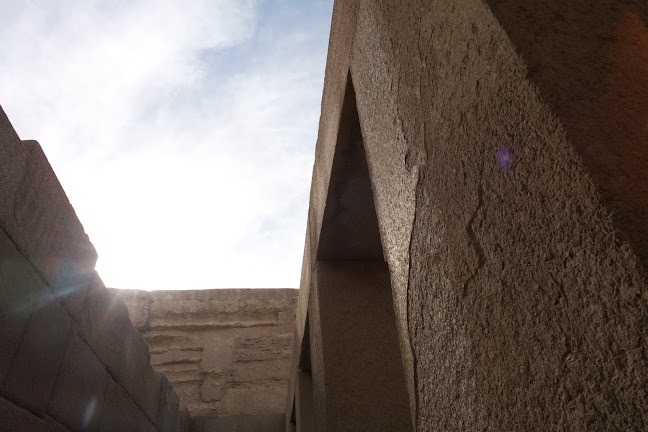
The presence of a layer on Egyptian stonework also
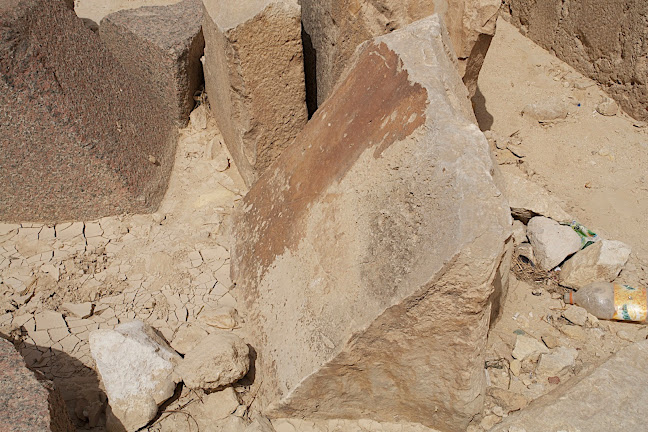
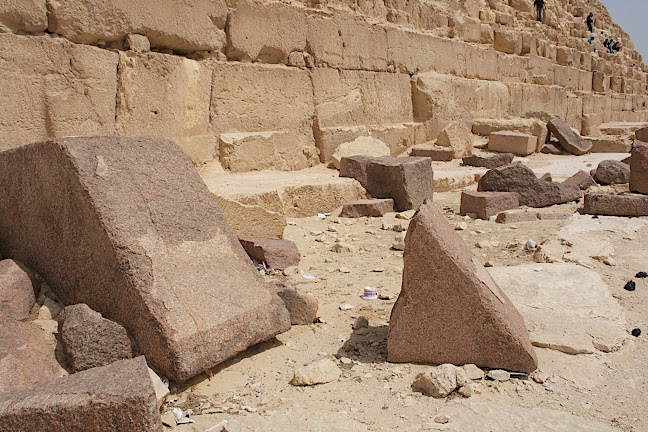
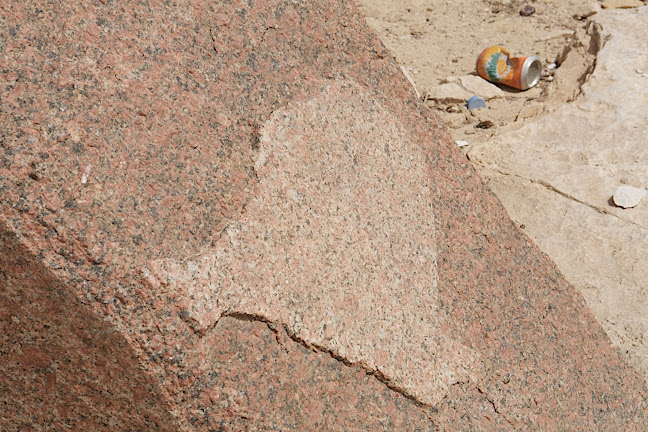
The advanced stonework in Egypt seems to have the same even and thin layer on the surface as one can find in Peru! Holger Isenberg took pictures there during a tour and is someone who knows how to look. See the pictures and compare with my pictures of the last blogpost of Ollantaytambo and my pictures of vitrified stones here.
This picture is of the Osireion temple is quite self explaining; there is the shiny layer and the layer is chipping off. I have seen more examples on video and pictures of these same walls; it is all over, only it depends a bit on how the light falls on the wall if one sees it on film or picture or not. According to most geologists it would be all because of salt weathering. Difficult to believe; something else must have happened that especially this stonework shows the vitrification and the layers chipping off. Below a few more pictures of stoneblocks that are close to the great pyramid and show a layer with a different color than the rest of the block.
 |
| © Holger Isenberg |
 |
| © Holger Isenberg |
 |
| © Holger Isenberg |
 |
| © Holger Isenberg |
Saturday, April 5, 2014
Ollantaytambo megaliths show a very even layer that is "peeling off"


Also according to him, the layer is peeling off because the surface was treated with heat. It caused the formation of a layer with a different chemical composition, glass like, and that is the reason that in time the layer looses the connection with the rock below it. There are definitely many examples to be found all over the inca sites. Another reason to believe that this is not a typical geological phenomenon, is the fact that it can be seen on many different kind of stones. See also the picture on the left where we see the reflection on a big part of the layer.
Some geologists seem to think that the shine is because of polishing and also that the layer peels off because of having been polished. The temperature explanation makes more sense to me, besides that inspection of the rocks and stones at the sites themselves made it clear that vitrification is for real. A chemical analysis of the layers of these rocks would certainly give more insights on how these megaliths were constructed. A pity that archaeologists normally miss the point and rapidly accept the polishing explanation.
For more on the vitrification of rocks, see here; Vitrified Stones
Do you want to come and see it and make your own opinion, join us on our August jounrey with the USOKS, see Tour Peru August 2014
Friday, April 4, 2014
Cool Hanan Pacha site that nobody cares about; near Lake Titicaca between Puno and the Bolivian border

 This rock on the video below we found beside the road between Puno and the Bolivian border. We were on our way to Tiahuanaco and Puma Punku, places that are just across the border in Bolivia, to film for our documentary "The Cosmogony of The Three Worlds".
The rock is a typical Hanan Pacha site. Have a look at the video and if you have been following some of our work you will recognize what I mean. This site is near to another typical Hanan Pacha site, namely Amaru Muru, a very big portal made into the living rock. The place has been used for graffiti for the elections as you can see, and is overbuilt with a kind of watchtower from modern times. It seems not to be taken into account as an ancient monument, but with the information of the Gamarra's, we do know it is!

Friday, December 27, 2013
With Jesús Gamarra exploring Inkilltambo, unknown but stunning site near Cusco
Stunning site near Cusco still hidden from mass tourism with amazing Hanan Pacha structures along a small river in a beautiful valley. Jesús Gamarra took us (Anne Tittensor, Bob Newton and Jan Peter de Jong) to here. We had the luck to find a track where we could enter with a 4 wheeldrive, not recommendable to do for touristsbusses or for a normal taxi though! We left the car at the end of that dirtroad, and from there it was like 1 km. hiking.
Photo Gallery by QuickGallery.com See also another album that I made later with more pictures:
Photo Gallery by QuickGallery.com
Photo Gallery by QuickGallery.com See also another album that I made later with more pictures:
Photo Gallery by QuickGallery.com
Subscribe to:
Posts (Atom)